

Harts Farm Way in infrared
I am slowly becoming accustomed to infrared photography, with the “full spectrum” Lumix µ4/3 camera that by Protech Photographic recently converted for me. I’m finding that near-infrared images can make even very boring ugly things look quite interesting. So I decided to pop out to what is generally reckoned to be the ugliest of Havant’s infamous ugly-spots, Harts Farm Way.
Harts Farm Way is where you can find the the local water treatment works, the household refuse recycling plant and the a large electrical substation. Though I have to admit, I do have something of a penchant for large substations and electrical pylons. In order to access Harts Farm Way meant crossing over the busy A27 Havant Bypass. This is part of the 357 km Folkestone to Honiton Trunk Route. So I grabbed a couple of snaps of that too.
Gallery


My kit
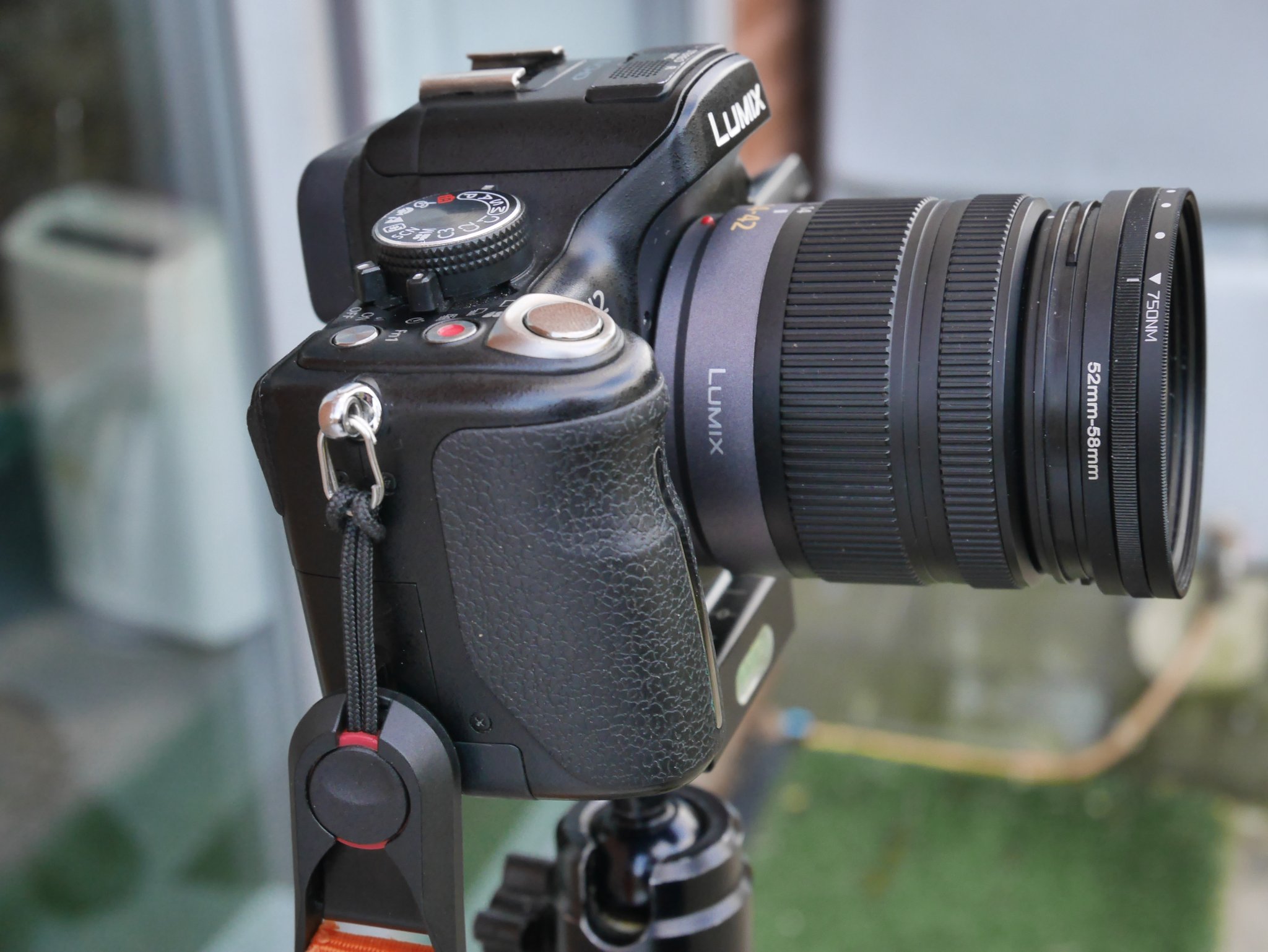
As with most of my IR work so far, I used a Fourth Eye variable infrared filter, screwed on the front of a bog-standard Lumix 14mm-42mm “kit lens”. Whilst this is not considered a great lens, it seems perfectly adequate, one might even say ideal, for near-infrared. This time, my variable infrared filter was set between 630nm and 760nm. The near-monochrome shots are the ones shot with the longer wavelength light.
Links
- geo URI (RFC 5870):-
geo:50.84714,-0.99853



Loved these infrared shots! Some of them gave me the “Chernobyl” feel. A strong set of images.
I haven’t played with infrared since film days but you have prompted me to think about having a go. Your filter route is interesting and I think I would prefer that to having a camera converted.
Keep up the good work!
Ace
Thank you. They do have a sort of post-apocalyptic feel. Though that part of town feels like that even without an IR filter! lol.
However the camera itself actually was converted to “full-spectrum”. Basically this conversion involves removing the factory 400nm – 700nm filter from the sensor so the camera can see everything that the sensor is capable of seeing, including light outside the human-visible spectrum. The variable filter that one screws on the end of the lens then selects which light is let through. In fact, I also have a second filter, a 400nm to 700nm band pass filter, that effectively converts the camera back to how it was before the conversion. Actually, it’s not quite as good as the original factory filter. Built it does mean that when one is “in the field” one can quickly make this camera behave almost like an ordinary camera too.
A full spectrum camera can be used without the variable filter too. In which case it would see from 350nm (slightly into ultra violet) up to about 1200nm (well into “near infrared”). Which means it can also be used at night, much as a security camera would be, capturing any light that the sensor sees. But in daylight using the camera this way makes colours look horrible.
Important thing here: if you tried to use that variable filter on a camera that hasn’t been converted, you lose about ten stops!
You might find this a useful read:-
https://garfnet.org.uk/cms/2025/12/26/more-infrared/